

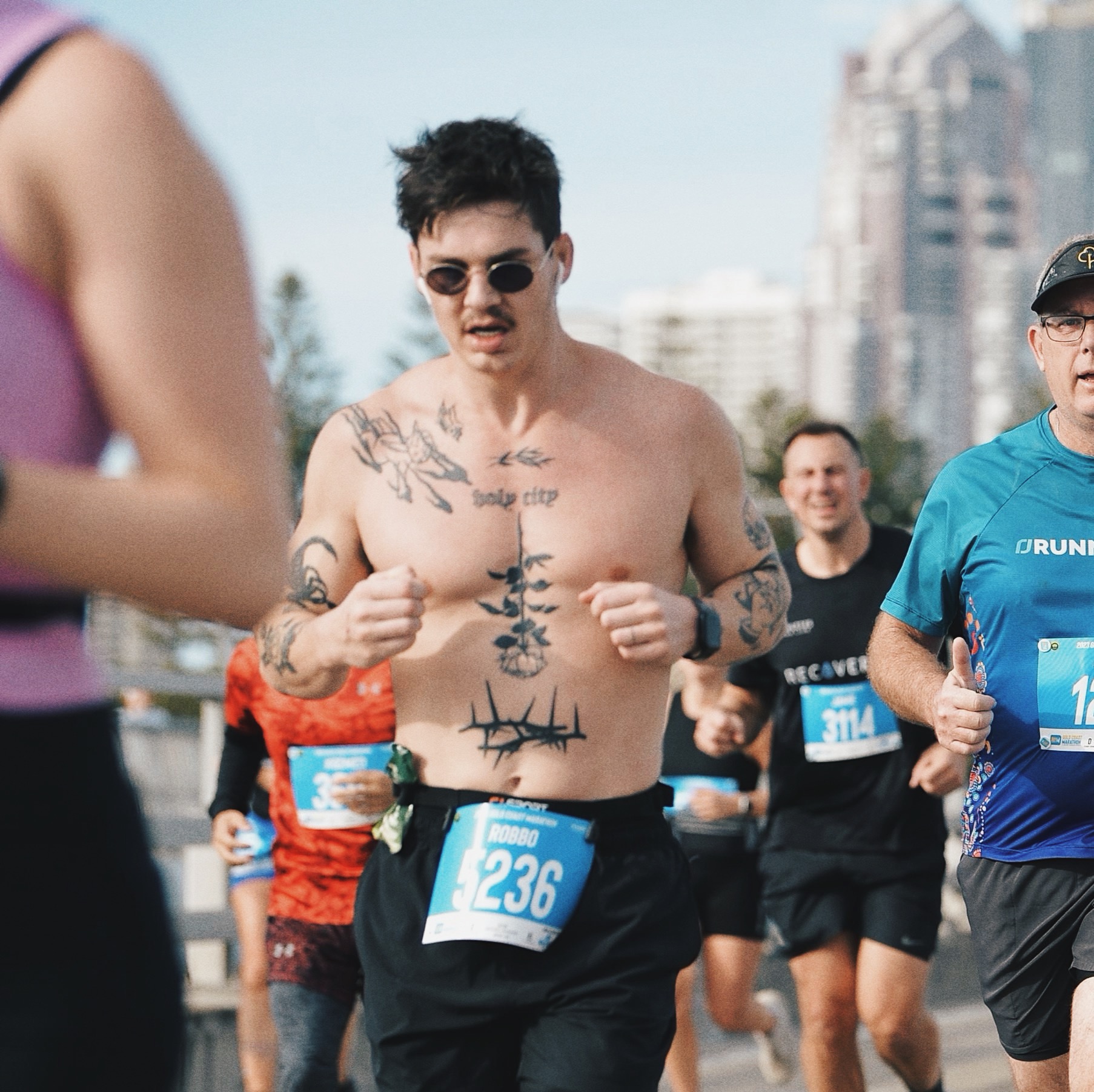
Around half of runners get injured each year. It’s frustrating, but it’s also very understandable once you see what’s going on.
The take-home
Running injuries are a mismatch between load and capacity. Modify the load, build capacity with heavy strength training, return gradually with a walk-run program, and train smarter so you stay running.
In this article

Most running injuries are load errors
The simplest way to think about it: an injury happens when the load you’re putting through a tissue exceeds what that tissue can currently handle. Running technique and body shape don’t directly “cause” injuries. They mostly determine where the overload shows up.
A few things worth knowing:
- Previous injury is the biggest risk factor. For example, someone who has had a bone stress injury is much more likely to have another.
- Overuse injuries often show up three to six weeks after the training mistake that caused them.
- Slower runners take far more steps and spend much longer on the ground over the same distance than faster runners, so they accumulate more load per kilometre.
- Stress, poor sleep and under-fuelling all reduce how well tissues recover.
- Some antibiotics (fluoroquinolones) can weaken tendons for months afterwards. Worth mentioning to your physio if you’ve had them.
- And no, recreational running doesn’t wreck your knees. It’s actually associated with lower rates of knee and hip arthritis.
Age changes the injury
- Runners under 40 tend to get knee and bone problems: kneecap pain, shin splints, stress fractures.
- Runners over 40 tend to get soft tissue problems: Achilles tendon pain, calf strains, plantar heel pain and gluteal tendon pain, because tendons get less springy and muscle mass declines with age.
The rest trap
Tissues adapt to the load they’re given. Rest completely, and your tendons, muscles and bones become less capable. Then when you return to your old training, you’re more likely to break down again. Underloading is just as much of a problem as overloading.
The answer is to reduce the irritating load while you build capacity.
Heavy strength training is non-negotiable
To make tendons stiffer and stronger, you need heavy loads (roughly 10 reps or fewer at a challenging weight). Light, high-rep exercise, even to failure, barely changes tendon stiffness. Running alone for months doesn’t change it much either.
One more surprise: getting stronger in the gym doesn’t automatically change how you run. Strength work builds capacity; changing your running technique requires practising while running.
Don’t forget the calves. When you run, the soleus muscle in your calf handles forces of around six to eight times your body weight with every step. It’s the engine of distance running.
Train smarter: easy really means easy
Many recreational runners do most of their runs at a moderately hard pace, too hard to recover from and too easy to build speed. A better split is around 80 percent genuinely easy (you can chat comfortably) and 20 percent hard. Build for two or three weeks, then have a lighter week.
How much discomfort is okay in rehab?
- 0 to 3 out of 10 is ideal; up to 4 or 5 is okay if it settles quickly
- The morning rule: if you’re stiffer or sorer the next morning, yesterday was too much
- For tendons, no discomfort at all can mean you’re not loading enough
The cadence tweak
If your physio spots overstriding, a 5 to 10 percent increase in step rate is the single most useful change. It reduces load on the kneecap by around 20 percent and reduces impact and braking forces. You don’t need to hit 180; it’s a relative change. It doesn’t need to be permanent either.

Before you start running again
Make sure you can comfortably manage:
- 10,000 to 12,000 steps a day, and
- a continuous walk of 4,000 to 5,000 steps (3 to 4 km)
without symptoms. Your first run-walk session adds up to several thousand steps, so this is your foundation.

A simple walk-run plan (three times a week, with rest days between)
| Week | Run | Walk | Repeats |
|---|---|---|---|
| 1 | 1 min | 2 min | 7 |
| 2 | 2 min | 2 min | 6 |
| 3 | 3 min | 1 min | 6 |
| 4 | 5 min | 1 min | 4 |
| 5 | Continuous running as tolerated |
Warm up and cool down with five minutes of walking. Do your strength work on the same days as your runs, so your rest days are genuine rest days.
Surfaces matter depending on the injury
- Achilles or plantar heel pain: flat, firm surfaces are usually best early on. Avoid hills and soft sand.
- Kneecap pain or ITB pain: a treadmill at a small incline (3 to 5 percent) is often well tolerated. Avoid downhill running early.
- Shin or bone stress injuries: softer, smooth surfaces like firm grass or smooth trails can help.
Thanks for reading! If this sounds like you, I’d love to help you work out what’s going on and build a plan that fits your life.
This article is general information only and isn’t a substitute for personalised advice. Everyone is different, so if you’re unsure, book an assessment or speak with your GP. If you have severe or rapidly worsening symptoms, seek urgent medical care.